
Understanding the Connection Between Metabolism and Body Composition
You probably do not think about your body composition when you are thinking about your metabolism. But you should.
By understanding the intricate relationship between metabolism and body composition, you will have a better grasp of the multifaceted nature of our body’s functioning.
In this post, we will delve into the fascinating relationship between metabolism and body composition, uncovering how they influence each other to make better lifestyle choices that support our overall health and well-being.
What is Your Metabolism?
While many people often think about it in terms of speed: “My metabolism is fast” or “My metabolism is slowing down,” people are naturally afraid of their metabolism slowing and the weight gain they know comes with it. To some extent, those worries are well-founded.
The Mayo Clinic defines metabolism as “the process by which your body converts what you eat and drink into energy. During this complex biochemical process, calories in food and beverages are combined with oxygen to release the energy your body needs to function.”
Notice how it does not mention anything about the speed at which you process your food. That would be digestion.
Basal Metabolic Rate
In medical terminology, metabolism is known as your Basal Metabolic Rate (BMR), which is the minimum number of calories your body needs to perform basic bodily functions. BMR is usually expressed in terms of calories. Your Basal Metabolic Rate also has another interesting quality: the more Lean Body Mass (which includes muscle, water, and minerals) you have, the greater your BMR will be.
When we talk about metabolism, we should always start the conversation with how many calories your body needs. But because your BMR and Lean Body Mass are linked, that means any conversation about metabolism becomes a conversation about your body composition.
Related: What Does Your Body Water Percentage Say About You?
How Your Body Composition Is Linked To Your Metabolism
Why is it that some people seem to be able to eat whatever they want and never experience any weight gain, while other people — even skinny people — feel like whenever they have one bite of dessert, it instantly goes to their waistline?
The reason is that metabolisms can vary in size. Take a look at these two body composition profiles, and see if you can spot the difference.
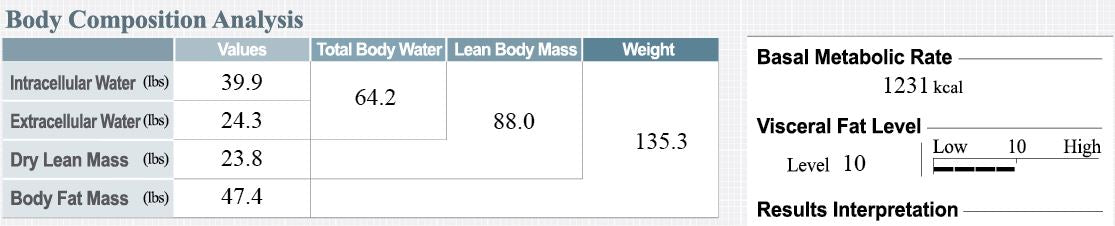

Beyond the obvious differences in weight, Person A has a much smaller Basal Metabolic Rate than the second. This means Person B needs more calories than Person A to provide their body with the necessary energy to function without losing weight. Because the BMR is bigger, the metabolism is “bigger.”
Greater than height and gender, the most important factor playing into BMR is the amount of Lean Body Mass each person has. That’s because, as research in the American Journal of Clinical Nutrition states, the more Lean Body Mass you have, the greater your Basal Metabolic Rate will be. That is why strength training for muscle gain, which in turn will increase your lean body mass, is recommended as a way to increase your metabolism.
This is why people who are big or above average in weight can eat more than smaller people. Their body requires them to eat more to maintain their weight, specifically their Lean Body Mass.
OK, you say, but these two people are very different in body weight — of course, the second person will have a bigger metabolism. Take a look at the two people below, whom we will call “Jane” and “Sarah”, two individuals who are similar in age, height, weight, and gender.
An Illustrative Example: Jane and Sarah
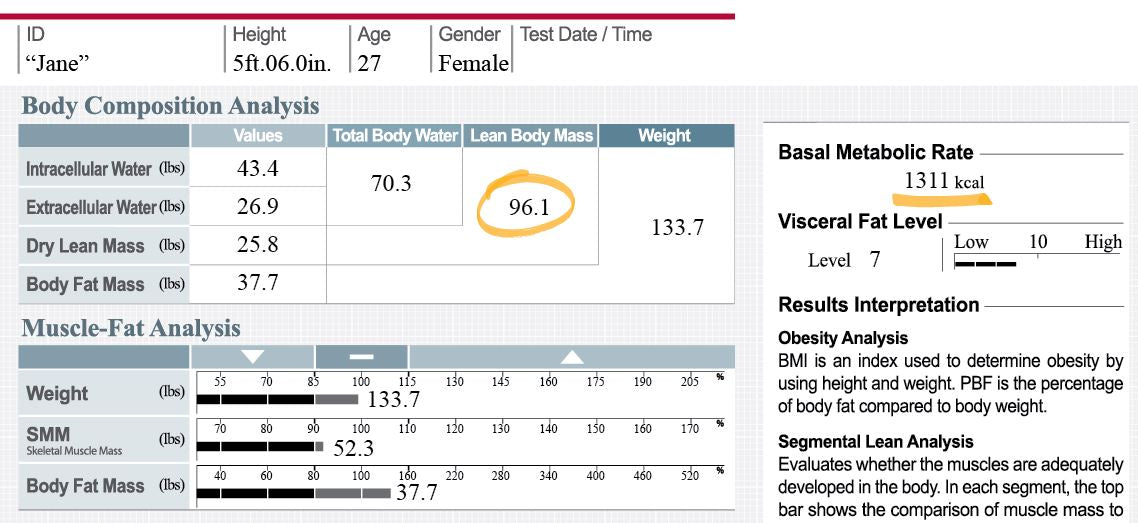
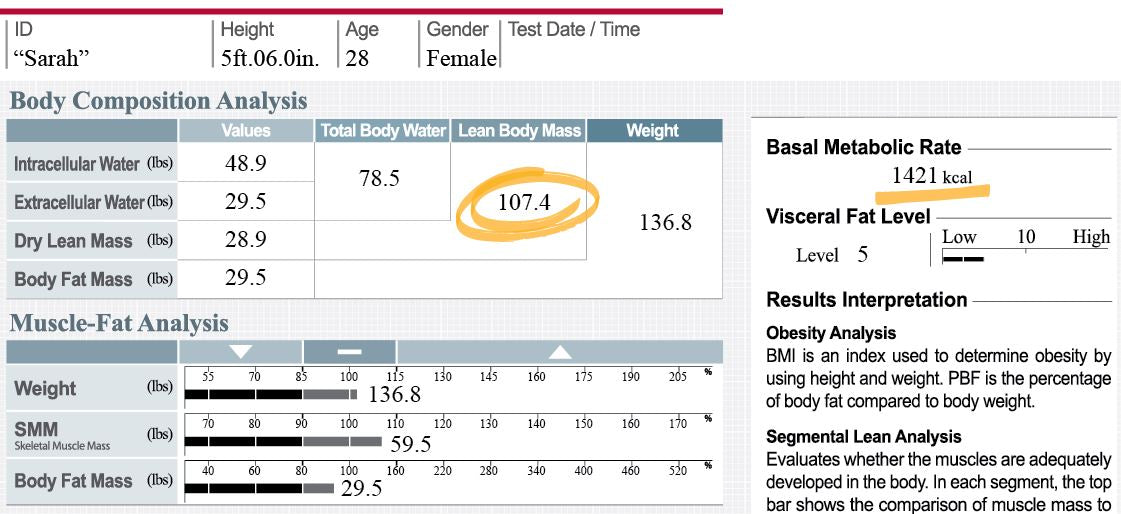
Despite being similar in age, height, weight, and gender, these two people have very different body composition profiles. As a result, they have different Basal Metabolic Rates. Although Jane has a body weight within the normal range (identified by being near the 100% mark), her body composition is defined by having more fat mass and less lean body mass and skeletal muscle than Sarah.
The person below has a lower body fat percentage and more Lean Body Mass — which is why, when looking at this person, you’d describe them as “lean.” Again, because this person has more than 10 pounds more Lean Body Mass, her Basal Metabolic Rate comes out to be over 100 calories higher than the person above.
Metabolism and Weight Gain Over Time
Let’s take a deeper look at what you might call a “slow” metabolism. Far from being an issue of fastness or slowness, weight gain is almost always the result of a caloric imbalance that goes unchecked over a long period of time.
But first, something needs to be clarified — your Basal Metabolic Rate is not the only factor that plays into your overall caloric needs, and it is not the total amount of calories you need in a day.
There are two other major influencers, which are:
- Your energy level — how active you are
- The thermic effect of food — the energy your body uses to digest your food
These taken together with your Basal Metabolic Rate provide your Total Daily Energy Expenditure (TDEE). This is the number of calories your body burns in a day.
BMR is a necessary piece of information to estimate TDEE. Although they are not exact, equations exist for estimating your TDEE based on your activity level and BMR. These are based on multiplying your BMR with an “activity factor” — a number between 1 and 2 — that increases the more active you are (and decreases when you are less active, regardless of your appetite).
Jane and Sarah’s Example Continued
To take a closer look into metabolism and weight gain, we will take the two people whose body compositions we have looked at above — Jane and Sarah — and see what could happen in a real-world example while also accounting for diet and exercise.
Estimate Total Daily Energy Expenditure (TDEE)
For this exercise, we first need to estimate TDEE for Jane and Sarah, using their BMRs as a guide. Based on Jane and Sarah’s compositions, it would be fair to assume that Jane does less exercise/is less active than Sarah, so we’ll assign an activity level of “Sedentary” for Jane and assign “Lightly Active” for Sarah
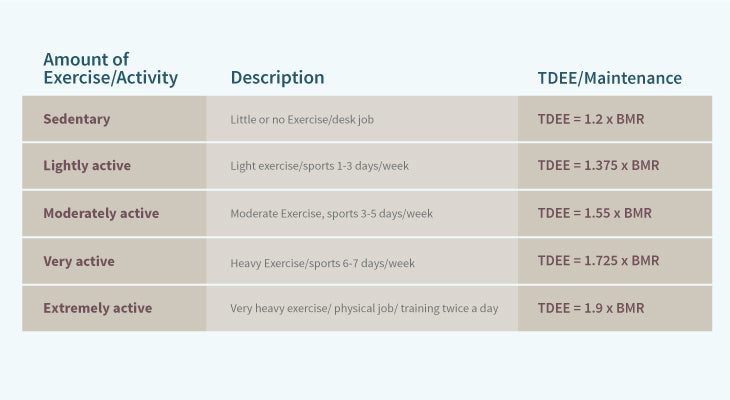
Using these numbers and multiplying them by the appropriate activity factor, we can estimate Jane’s TDEE to be 1,573 calories and Sarah’s to be 1,953 calories, a difference of 380 calories.
Notice how, although the difference in BMR was a little over 100 calories when activity levels were factored in, the difference in actual caloric needs became magnified.
Calculating Caloric Intake
Now that we have an estimate of the calories Jane and Sarah will need/burn in a day, let’s give them calories to take in. Let’s put them both on a diet of 1,800 calories a day — the estimated caloric intake suggested by the USDA for sedentary women between the ages of 26-30.
Assuming that Jane and Sarah both follow the 1,800-calorie diet perfectly without any extra, high-calorie snacks or treats, Jane would end each day with a calorie surplus of 227 calories/day. Sarah would end each day with a slight calorie deficit of 153 calories a day.
When you are in a caloric surplus — taking in more calories than you use — and live a mostly sedentary lifestyle, you will experience weight gain, specifically, fat. An extra 227 calories a day might not seem like a lot at first — that is about a single soda — but over time, a surplus of 227 calories a day becomes 1589 extra calories a week and a surplus of 7,037 extra calories a month — roughly 2 pounds of fat gain per month.

Key Takeaway
Despite being the same height, same gender, similar weight, and similar ages, because of the difference between Jane and Sarah’s body compositions, Jane will experience weight gain over time while Sarah might experience some weight loss because of her calorie deficit, even though their diets are the same. That’s because the differences in their caloric needs, although seemingly small at first, increase to significant differences when allowed to persist over time.
Age and other factors aside, the focus lies on how their body composition influences their metabolism and caloric requirements.
Making Your Metabolism Work For You
Because your metabolism is not something that slows down or speeds up depending on things like age, this gives you some control over it. With the correct exercise and dietary plan, you can make your metabolism work for you!
Improve and Increase Your Metabolism
It all goes back to improving and maintaining a healthy body composition.
Because your body needs more energy to support itself when it has more Lean Body Mass, working to increase your Lean Body Mass can increase your Basal Metabolic Rate, which can have a huge impact on your TDEE once you factor in your activity level.
Avoid a Decrease In Your Metabolism
For many people, simply maintaining their metabolism or avoiding a “slowdown” (which, as we have seen, is a myth right up there with muscle turning into fat) is an important goal.
So, how can you avoid a decrease in your metabolism? One main way is by maintaining the Lean Body Mass that you already have. That means maintaining your Skeletal Muscle Mass.
Your Skeletal Muscle Mass is not the same as your Lean Body Mass, but it is the overall biggest contributor to it. It is the muscle that you can grow and develop through exercise and increases or decreases in SMM have a strong influence on increases or decreases in Lean Body Mass.
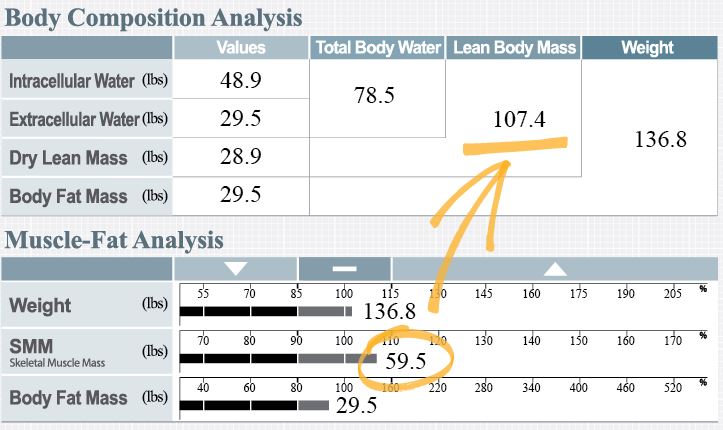
Skeletal Muscle Mass is best developed through strength training and resistance exercise along with a proper diet. A regular exercise plan that includes strength training and resistance exercise will help you maintain your Skeletal Muscle Mass.
This can be especially important as you age. As people become older and busier, activity levels tend to drop, and a proper diet can become harder to maintain as responsibilities increase. Poor diet and nutrition can lead to a loss of Lean Body Mass over time, which leads to a decrease in overall metabolism — not a slowdown.
Balance Your Diet With Your Metabolism
The example of Jane is a good example of a well-intentioned dietary plan that does not match the metabolism of the person practicing it. Even though Jane has been led to believe that 1,800 calories are right for her based on age and gender, her metabolism does not require that caloric intake, and she will end up gaining weight despite her efforts to eat a healthy diet. In the end, she will probably end up blaming her “slowing metabolism.”
It is examples like Jane’s that show how important understanding the link between metabolism and body composition is.
Related: Do Skinny Shots Work for Weight Loss?
Should I Start a Weight Loss Program?
How much Lean Body Mass do you have? What might your Basal Metabolic Rate be? These questions should be answered first before starting any weight loss or diet program, as well as conversations about metabolism.
The first step is always to get the information you need to get the answers to these questions by getting your body composition accurately tested. Your metabolism and your body composition are strongly linked, so to truly understand your metabolism and weight, you must get your body composition tested.
Get the Body of Your Dreams at Aqua Vitality
Discover the path to achieving the body you have always dreamed of through Aqua Vitality’s transformative weight loss services. With carefully crafted programs designed to guide you through a holistic and empowering process, we go beyond conventional approaches to weight management.
Our expert team is dedicated to crafting a tailored approach, considering your unique goals, body composition, and lifestyle. Not only will we help you shed the extra pounds, but also help you nurture a healthier relationship with your body.
To learn more about our weight loss services and how you too can feel confident in your body again, click the button below to get in touch with our team!
This blog post was originally written by InBody in December 2020 and refreshed in August 2023.